
Academics
as a profession: what does it mean? Does it matter? Simon Schwartzman
Paper prepared for the International Conference
on Higher Education, Stockholm, Sweden/ Turku, Finland, 13th to 15th of
August, 1993. I am grateful to the Swedish Council on Higher Education for
support. Published in Higher Education Policy, 7, 2, 24-26, 1994.
The Carnegie Foundation survey on the professorate takes for granted
that university professors make a distinctive profession. This is a perfectly
reasonable assumption, shared by a growing literature. But what does it
mean to say that professors are a profession? Is this concept more than
a statistical or administrative classification? How important it is to
know whether academics are truly a profession, in general and in specific
contexts? The contention of this presentation is that, indeed, to be or
not a profession is much more than a formal classification, and has important
consequences in terms of how universities are organized and work.
1. What is a profession?
A profession is a group of persons who share a similar occupation, a
common basis of knowledge and skills, and a distinctive standing in society.
They are also supposed to share a common set of values, including the
pride for their competence and standing, and the desire to keep their
occupation under autonomous control and supervision. Professionals are
proud of the services they provide, but do not like to see themselves
as hirelings, selling their services to the higher bid, and catering to
the desires of their clients. They prefer to see themselves as working
for a noble cause (the causes of knowledge, health, justice, peace), and
expect to receive the proper acknowledgement and financial compensations
for their dedication. Professions are assumed to be the best institutions
for the preservation and development of technical traditions, the stimulation
of creativity and competence, the protection of society against quackery,
and the defense of the professionals' own lifestyles.
This ideal type of a profession, which has its origins in the medieval
cities, where the first universities also appeared, has gone through important
transformations and adaptations. There are at least three very different
types of professions today, and we should ask ourselves to which the academic
profession belongs.
The first is the liberal profession, best represented by the independent,
free standing medical doctor. He works autonomously, decides what his
clients need and how much they should pay, and is only limited by the
norms and ethics of his equals. His status is based on the specialized
knowledge and academic credentials he has acquired through an extended
process of education and professional initiation, controlled by his elder
colleagues. The rituals of initiation and graduation are supposed to guarantee
and acknowledge his competence, and make sure that no one without the
proper credentials and qualifications should offer to society their services.
The second is the unionized skilled worker, which is the direct heir
of the medieval guilds. Until the recent past, craftsmanship was transmitted
from father to son, or from master to pupil, and the guild's control of
professional initiation and professional practice was similar to that
of the liberal professions of today. The craft professions were affected,
however, by two important trends. The monopoly they retained on their
specialized skills was eroded by the introduction of modern machinery,
the division of labor of modern industrial production, and the development
of organized technical training. And the introduction of large-scale industrial
employment made the independent craftsman and his family enterprise a
thing of the past. The skilled workers lost two of the main elements of
a classic profession: the monopoly and control of specialized knowledge,
and professional independence. They developed the ability to organize
and negotiate their salaries and working conditions with their employers
and governments, and often joined political parties to influence society
as a whole. In countries with a strong craft tradition, unions tended
to get organized along professional lines, and retained some of the tradition,
culture and shared abilities of the past. The term "profession," however,
in many societies, migrated from the craftsmen to those with a university
education, to characterize what are known today as the "learned professions."
The third type is the civil servant in the modern bureaucracies, well
educated in the schools of law, the military academies and in high prestige,
public institutions, such as the French École Polytechnique or the Tokyo
University. Rituals of admission and professional practice are strongly
enforced, both for education and for professional practice. Like the liberal
professional, the civil servant keeps the pride and the prestige of a
learned profession; but, like the unionized worker, he is not free to
decide his career, which has to follow the general rules and procedures
of the central authorities. He shares with the other two, however, the
professional identity and the "sprit de corps" which allows him to negotiate
the terms of and conditions of his work, which includes the control of
the initiation mechanisms and educational procedures for admission to
his trade. He is, to use Fritz Ringer's image, the modern version of the
Chinese mandarin.
2. Scholars and mandarins
Depending on the country and the historical time, the academic profession
has taken different elements of these three ideal types. In centralized
societies such as Prussia and France, and in Europe more generally, the
university professor has been a member of the civil service, like a judge
or a military officer. Dispersed among different specialties, the academics
did not share a common knowledge basis, but had in common the values of
science, education, scholarship and, more generally, the culture obtained
through a highly selective system of secondary education. They were perceived,
to use Harold Perkin's expression, as the key profession, responsible
for setting the standards and imparting the fundamental knowledge required
by the other learned professions. To do this, they had to place themselves
at the very source of knowledge production, as researchers and scholars,
from which their work as educators should result.
This was the ideal of the Humboltian university, which became the model
to be emulated in other countries since the nineteenth century. However,
comparative studies showed that, beyond the similar façade of a state
supported, homogeneous academic profession, there were differences that
explained the professional and scientific achievements of academics in
different countries. Joseph Ben-David argued that the success of the German
university depended not on its organization as a coherent body of the
civil service, but on the competition that existed among universities
for the best academics and researchers, and, one may add, on the special
links that German universities established with industry, particularly
in chemistry. In this the German academic worked more like a free-standing,
independent intellectual, than as a member of a fixed and well-established
corporation. Fritz Ringer's thesis can be construed as the opposite side
of the same argument: because the German academic was also a mandarin,
he was led to place the values of hierarchy, authority and nation above
those of individuality and freedom, and contributed, in his own way, to
the downfall of Germany into authoritarianism. A side note on this apparent
contradiction is that, while Ben-David was mostly concerned with the development
of the natural sciences, Ringer's attention was drawn to philosophy, history
and the social sciences, which provided the cornerstone of the German
ideologies.
One could look for parallels, contrasts and tensions between the "mandarin"
and the "free standing" academic in other higher education systems and
societies, and probably would come to similar conclusions. Whenever the
institutions allowed the academics to see themselves as members of a scientific
community, free to move between institutions and even countries, their
effective involvement with actual research was higher, and the quality
of the education they provided was better. One of the first results of
the Carnegie Comparative study is that, today, academics see themselves
above all as members of their academic discipline, and do not give much
importance to their institutional affiliation. This is particularly striking
in the United Kingdom, Netherlands, Japan, Israel and Korea, and less
accentuated in Brazil and Mexico, where the academic roles of researcher
and scholar and are not as clearly established. The impressive achievements
of American higher education and research can be attributed, in part,
to the almost total absence of the "mandarin," notwithstanding the ascendancy
of the Ivy League, and to the intense mobility of their academics. It
is paradoxical that in Europe, and in most countries that copied the European
model, higher education remained much closer to the standards of the civil
service and the values of the mandarinate than their experience would
recommend.
3. Academies and unions
The opposition depicted above between the academic and the mandarin is
just one dimension in a much more complex pattern of organization of academic
work. University professors have a teaching job to do, and, as higher
education increased its reach, it became more relevant for more people,
and more expensive for government and society. In most countries - and
this is truer for large than for small societies - it became more differentiated,
with different people looking for different types of education. Some students
still yearn for the learned professions, but many are only looking for
practical training for a specialized job, wanting to improve their general
education, or simply following the educational path of their cohort. The
socialization of academics through a common secondary education, or at
least a uniform state examination, became also more difficult to maintain
and justify. In many cases, academics still see themselves as a members
of a learned profession, based on the values of research and scholarship.
As often as not, however, they are just employees in large institutions,
with a job to do and a salary to earn at the end of the month. Their motivation
and values may lie elsewhere. Instead of a life-long career, their passage
through the academy may be temporary, and, even if its not, they may be
more committed to his specific profession than to the university and its
values.
This is the breeding ground for a new type of academics, who are much
closer to the professional unions than to the learned professions. They
work for large organizations, very often controlled by a centralized ministry,
who have to respond for the proper use of public resources and the delivery
of education services in appropriate quantity and time. They respond in
kind, getting organized in professional unions, to guarantee their salaries,
working conditions and benefits. On both sides, there is a strong pressure
towards uniform standards and procedures, due process, and clear rules
for admission, promotion and payment. Squeezed between the two is the
traditional academic, who prizes above all his individuality and independence.
He reacts by stressing his links with the international and the scientific
community, reducing the involvement with his institution, and looks for
support among the science financing agencies. By the same token, he avoids
teaching, and more specially undergraduate teaching. He sees his profession
as losing prestige, his institutions as losing autonomy, and his personal
intellectual freedom to decide what to teach and to do, curtailed. We
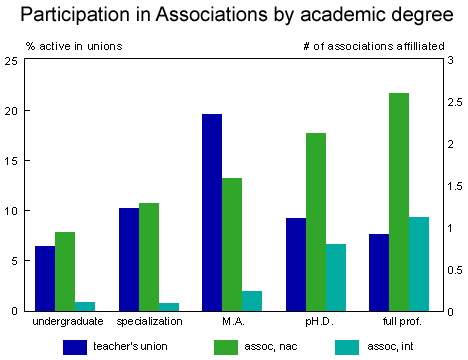
can observe this pattern in one of the countries in the Carnegie Foundation
study, Brazil, where the middle ranks in the academic career join the
unions, while the higher ranks give preference to their academic affiliations.
There is also a third group, at the lower ranks, who is not, in fact,
a member of the profession: his academic credentials are limited, he does
not have a regular working contract, and his personal involvement, whether
with the academy or the professional unions, is minimal (graphic).
4. Staff issues and the academic profession.
It is curious how the concept of "staff," of common use in administration,
is entering now the field of higher education. Its managerial connotations
are unmistakable. Universities are not, any longer, just the home of scientists,
the place of educators or the breeding ground of the elite. They are organizations
that have to deliver an efficient service, and, for that, have to get
and administer the appropriate manpower, the staff.
That this staff belongs to a profession, in one (or a combination) of
its different versions, is both unavoidable and essential to take into
account, if the managerial task is to succeed. Different countries and
institutions have tried to solve and improve their staffing needs through
attempts to foster one of the professional alternatives described above.
In many cases, there is an effort to move higher education in the direction
of the free-standing liberal professions.
Institutions are set free to look for their clients, professors are stimulated
to get their own sources of money and profit for them, and competitiveness
for resources, prestige and influence is fostered. The proclaimed benefits
of this orientation are well known; less clear, however, is the cost they
bring in terms of the alienation and conflicts with those that cannot
compete, or who perceive their social standing as something beyond the
mundane dispute for projects, contracts and evaluation points.
The other strategy is to insist on the universities as a distinguished
branch of the civil service. This leads to a stress in well structured
career patterns, public entrance examinations to the profession, job stability,
and reverence bestowed on the academic chair and the professor. The ability
to carry on such strategy depends on the country's size and cultural traditions;
it is more appropriate to small and well educated European countries,
for instance, than to large and heterogenous societies elsewhere. One
problem with this approach is that, even in the best of circumstances,
it is very conservative, since there is no stimulus for the professor
to change and adapt to new circumstances, and no flexibility for the institutions
to do likewise.
The third strategy is to see the universities as one among many modern
companies in society, and treat the academics as companies do with their
workers. If the workers are unionized, they have to learn to deal with
it. These learned companies will tend to organize the professor's work
according to clear rules related to working loads, well defined working
schedules and explicit productivity targets. If there is enough flexibility,
they can even adjust benefits to measures of performance. The danger in
this approach is that it threatens one of the central elements of a profession,
which is the autonomy to decide what to do and how to proceed, and take
a personal responsibility for it. Well-managed teaching companies can
be just that - well-managed teaching companies - and lack the dimensions
of prestige, intellectual leadership and role models which are essential
elements of the academic profession.
5. Conclusion
The three alternatives for the professionalization of academics - the liberal
professional, the mandarin and the union member - define the space in which
the modern universities have to move. They are related to three different
ways of managing higher education institutions - like professional markets,
the civil service or service companies. Each of these alternatives have
their rationale, and their adoption depends, in large part, on the cultural
and academic traditions of each society. Academic markets stimulate competitiveness
and achievement, the civil service guarantees stability, competence and
prestige, and modern management assures effectiveness and good service.
There are no ready-made formulas for good university management, except
that in all cases, there should be a combination of the three elements,
depending on how the academic profession is shaped in a given context, and
to where one would expect it to move.
Bibliographical Note
Central references for this paper are the articles included in Phillip Altbach,
Comparative Perspectives on the Academic Profession. New York, Praeger,
1977, and Burton R. Clark, editor, The Academic Profession - National,
Disciplinary and Institutional Settings, Berkeley and Los Angeles, University
of California Press, 1987, including Harold J. Perkin's "The Academic Profession
in England". Joseph Ben-David's classic comparative study of the main European
academic traditions can be found in Centers of Learning: Britain, France,
Germany, the United States, Berkeley, the Carnegie Commission on Higher
Education, 1977. Fritz Ringer's work is The Decline of the German Mandarins
-- The German Academic Community, 1890-1933, Cambridge, Harvard University
Press, 1969.
<