
Health and Health Statistics in Brazil

Simon Schwartzman (1)

Prepared for the Joint Conference of the International Association of Survey Statisticians and the International Association of Official Statistics (IASS/IAOS), Special Organized Session on "Social welfare: monitoring living conditions by using social and health statistics, and other data sources," Aguascalientes, Mexico, Sept. 1-4, 1998.

Brazil is going through a very important demographic transition, which is changing the health conditions of its population in very significant ways. This transition requires a revision in the kind of data on health which are collected by the Brazilian Statistical Institute, IBGE, the Ministry of Health and other authorities. In this paper, we will make a brief presentation of the demographic changes, in terms of their effects in health; provide an overview of the existing data sources; and present a brief discussion on what is needed for the future.

The demographic transition and its impact on health

It is possible to summarize Brazil's demographic transition in terms of three or four main trends. They are:

- urbanization and metropolization: about 80% of Brazil's population live now in urban areas, and, of those, a large number live in metropolitan areas of one million or more;

- a dramatic reduction in fertility rates. The fertility rate is estimated to be 2.3 per women, and is projected to be 2.09 by 2,020. Population will still grow because of the age structure, but it is expected to stop growing by 2,030, 20 or 30 years from now.

- significant increase in life expectancy, and decrease in infant mortality. These are long-term trends, associated with urbanization, improvement in education, growing access to treated water and changes in reproductive behavior.

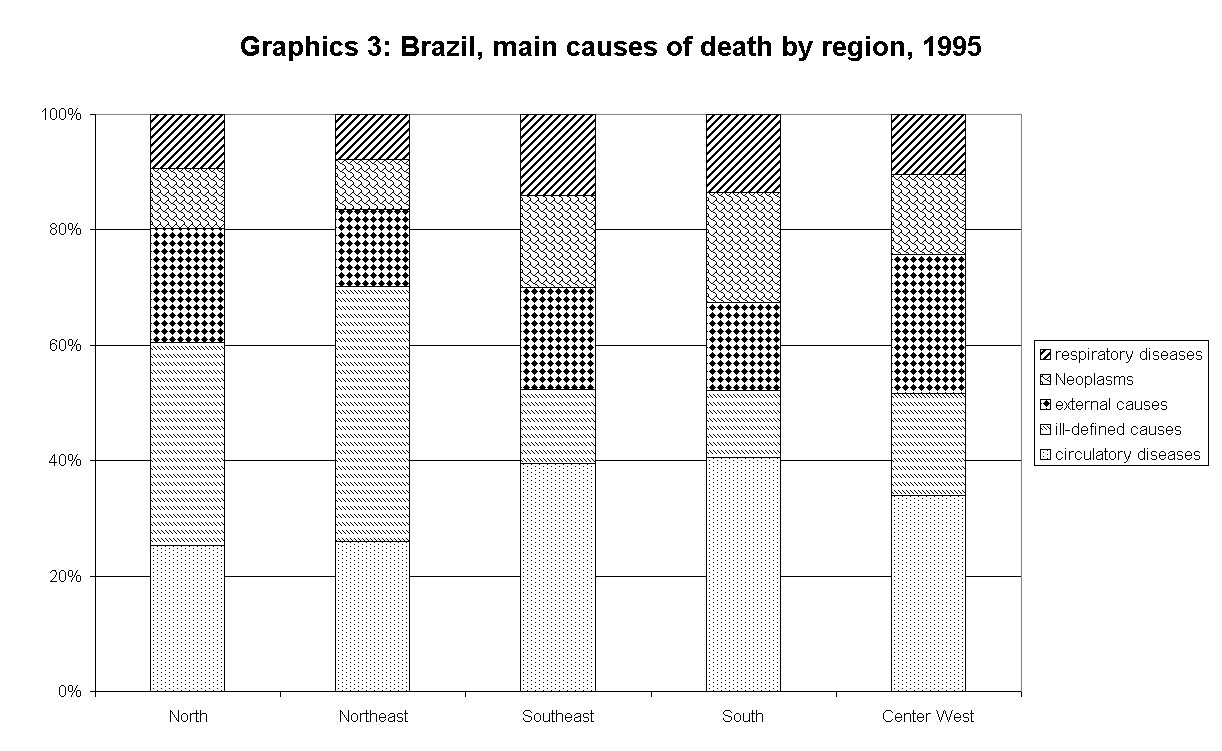
The main impact of these changes in health can be visualized in the graphics one and two below. They show how the health problems related with infant mortality are being reduced, and replaced by those more typical of the old, cardiovascular diseases and neoplasms. At the same time, there is a growing increase in the death rates of the young, caused typically by external causes (accidents and violence, homicides and suicides). The current pattern is more "normal" than in the past, but the health problems are more complex and difficult than ever. Health care for the elderly is more expensive than sanitary campaigns and primary care provided to the young; while most of the traditional infectious and viral diseases have disappeared or reduced to very low levels, others, like dengue fever, tuberculosis, are reappearing and proving much more difficult to control, and AIDS is taking the place, or growing side by side with preexisting venereal diseases.


Graphics 2 shows an important flaw in the Brazilian health statistics, which is the large number of deaths classified as "Sintomas, sinais e afecções mal definidas" - ill-defined symptoms, signs and diseases. These figures come from the information written in legal death certificates inscribed in the civil registries throughout the country. If about 20% of the deaths do not have a proper diagnostic by a competent physician, one can only guess at the number of errors that might exist for the records that have an identified cause. Not surprisingly, this lack of information is concentrated in Brazil's poorest regions:


The condition of health statistics in Brazil

The Ministry of Health in Brazil is the agency in charge of the systematization and dissemination of health statistics in Brazil. Today, most of its data is available in the Internet, at http://www.datasus.gov.br . The Ministry of Health gets its information from a variety of sources, including the state's health authorities, regional research institutes and Brazil's national statistical office, the Instituto Brasileiro de Geografia e Estatística, IBGE. IBGE is also responsible for providing the health authorities with the demographic information required for the calculation of health indicators.

It is possible to think on health statistics in terms of the following categories:

a) health indicators: information on the health conditions of the population, incidence and evolution of specific diseases, mortality.

Information on mortality derives from the statistics of the civil registries processed by IBGE (Estatísticas do Registro Civil) and by the death statistics collected by the National Epidemiological Center (Centro Nacional de Epidemiologia), linked to the National Health Foundation, Ministry of Health. The latter is responsible for presenting the data broken down by causes of death, an extremely useful information which is nevertheless hindered by the high proportion of unreported causes. The Ministry of Health handles a system of hospital statistics (Sistema de Informações Hospitalares) which provide data on hospital mortality, and specially on maternal mortality.

Data on specific health conditions and epidemics are collected by some national or state agencies, but there is no unified system of information on morbidity. The Internet page of the Ministry of Education Health lists several specific registries (Registro Hospitalar do Cancer, Registro Nacional de Patologia Tumoral, Registro de Cancer de Base Populacional), and there is mandatory notification by medical doctors of the occurrence of some specific diseases, such as AIDS, meningitis, cholera, and others, with different degrees of completitude.

There is no systematic data on anthropometric characteristics of the population, but the Living Standards Measurement Survey of 1996/7 included information on the weight of a sample of the population in the Northeastern and Southeastern regions, which can be correlated other caracteristics.

b) demographic information: data on population size, distribution and mobility, age structure, birth and death rates, reproductive practices.

The demographic information used in Brazil by the Health Ministry and other Institutions come from IBGE, which is responsible for the country's decennial censuses and a yearly national household survey covering about 100 thousand dwellings, which include information of the main demographic parameters. IBGE collects and publishes every year the statistics of births and deaths taken from the civil registries. The latter information, however, is limited by severe under reporting of births and infant deaths, particularly in the country's poorer regions. Comparisons between the data derived from the civil registry and the 1991 census showed about 30% of under reporting for births, and 44% of under reporting for infant deaths. Several measures are being taken to correct this situation. Until recently, there was a charge to be paid for a birth certificate, and this was eliminated. The Ministry of Health is creating an information system associated with the country's hospitals, which could deliver not only the gross figures on birth, but additional information on the children's condition and characteristics of the parents. In the meantime, demographic estimations have to be based on the indirect information provided by the census and household surveys,

c) socioeconomic and environmental data: information on income, education and living conditions that may affect the populations's health - housing conditions, access to clean water, sewage systems, clean air.

Most of the available information of this kind comes from IBGE. Both the decennial censuses and the annual household surveys include questions on the living conditions of the population and of specific services which are relevant to health - specially treated water and disposal systems. There is no systematic national information on air pollution, except in some places like the city of São Paulo.

d) data on private expenditure on health

Data on private expenditure on health is not collected systematically, but there are several sources on information. The Household Budget Survey (Pesquisa de Orçamento Familiar - POF) carried on in 1996/7 provides detailed information on household expenditures in all areas including health, and this information exists also in the Living Standards Measurement Survey (Pesquisa de Padrões de Vida - PPV) of 1996/7. POF is an extensive survey dedicated to the identification and measurement of the expenditures of the population, while PPV is an intensive, multi-purpose survey geared to the multi-variate analysis and interpretation of the living patterns of the population. In the past, IBGE has introduced suplements in the early household survey to deal with health, and a new health supplement is planned for 1998. This supplement will include information on access to health services, coverage, morbity, private expenditure and the use of health services. It will be the first time that the use of private health programs by the population will be investigated.

e) attitudes and behavior of the population in relation to health issues.

The Demography and Health Survey was carried on in Brazil in 1996 by the BENFAM association, with the support of several national and international organizations. It gives data on reproductive health, birth control practices, maternal and infant care, nutrition and inoculations of the infant population, anthropometric characteristics) and other aspects.

e) availability of health services and facilities

The main source for this information is IBGE's Medical-Sanitary Research (Pesquisa de Assistência Médico-Sanitária - AMS). It was carried on between 1975 and 1992, and will be done again in 1998, covering about 50 thousand health providing units in the country. It includes data on the existence of medical services, hospital beds, ambulatory services, health professionals, laboratories, blood banks, and so forth. It also gives information on whether the supplier of health services is public or private, and paid by the government or the public.

f) access to health services and facilities.

Some information of this kind can be obtained by the LSMS survey and will be available from PNADs health supplement of 1998. The household budget survey (POF) provides also information on the family expenditures on different kinds of health services, but not on the use of public health facilities.

g) public expenditure on health

Data on public health expenditure is available from government departments at the federal, state and local level. The unified system of health administration (SUS) is a rich source on information on public expenditures, broken down by types of diseases and other characteristics of the public and the health providers. The Ministry of Social Security (Ministério da Previdência) handles the public system of pensions and retirements, including those related to illnesses and accidents, and provides statistical information on the subject.

Availability of health statistics

In recent years, there has been an intense effort to place the information on health at the disposal of users of different kinds. IBGE includes health information in its Statistical Yearbook (Anuário Estatístico), with data generated by the Institute and other sources. Both IBGE and the Ministry of Health provide data through the Internet. And there is an ongoing effort being developed by the Ministry of Health and other agencies, with the support of the Pan American Health Organization, to create an integrated system of health statistics for the country.

Conclusion

The table below gives a picture of the different health indicators and their main sources. It is possible to see that there is data for all dimensions, but the quality and periodicity of these data are unequal. It is necessary to increase the coverage and accuracy of the registries and notifications of births, deaths and diseases, but this is a long-term goal, because it depends very heavily on the quality of the health services and care provided to the population. Information on the actual access and use of public and private health care is essential. It is also necessary to develop indicators on the quality and efficiency of the services provided. Brazil spends a very significant part of its resources on health, but there is a widespread notion that these resources are not being used as efficiently as they should, and very often do not reach those who are in greatest need. The unified system if health care adopted in Brazil - SUS - assumes that everybody is entitled to free health care, but it is obvious that this is not happening, and is not likely to happen, given the increasing demand and cost of health care, in a situation of an already overburdened public sector. Important changes in the country's health care system will have to occur sooner or later, and good data will be needed to make sure that the available public resources are used efficiently, and targeted to the right persons.

  Ministry of Health and Social Security Registries Census PNAD POF PPV (LSMS) AMS Registro Civil PNSN
health indicators xx   + (supplements)   x   xx xx
demographic information   xx xx   x   xx  
socioeconomic and environmental data   x xx x xx     xx
private expenditure     + (supplements) xx xxxx      
attitudes and behavior of the population in relation to health issues.       x x     xx
existence of health services and facilities xx   + (supplements)

 
xx xx   xx
access to health services and facilities. xx   + (supplement)   x     xx
public expenditure xx              


Note

1. President of the Instituto Brasileiro de Geografia e Estatística (IBGE). I am grateful to Lilibeth Cardozo Roballo Ferreira and Celso Simões for their help. <